
The terminal is still the integration point: why I built Workdash
how "why can't I just open a shell here?" ended up being the most frequent question that I have with any tool I use.

Workdash Website
On my daily life I maintain and contribute to multiple opensource projects and work repositories, which means I constantly juggle git repos, issue trackers, CI, reviews, terminals, coding agents, logs, and random operational tasks.
In the past I tried to keep up with all of this in many different ways: Emails, GitHub Notifications, Aggregators, the classic “I’ll just ignore everything, if it’s really important someone will ping me” mantra and even more odd automation I won’t share here because would only make your life worse and not better (no, really, don’t try to delegate your life organization to an agent).
None of those worked really for me, because most developer dashboards try to solve this by replacing your workflow with their workflow.
How I navigate my tasks (of course, here is a sidebar with what you have to do)
How I edit code (here! find this beautiful integrated editor)
How I interact with the repository (click this button to commit, it’s easy!)
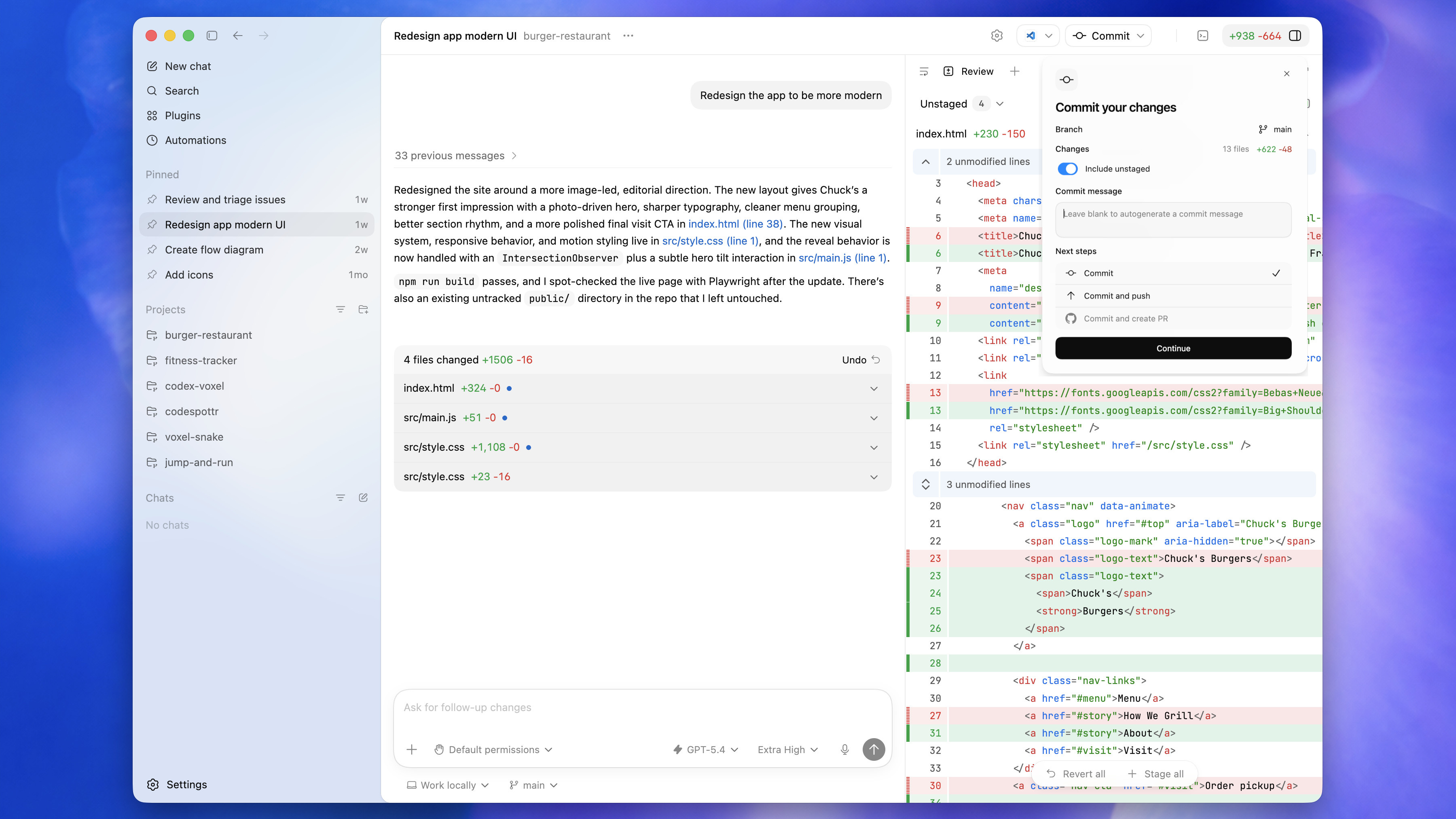
Your editor becomes secondary. Your terminal disappears. Git becomes a button inside somebody else’s UI. Eventually the dashboard becomes the place where everything must to happen.
And the most frequent question I found myself asking about was always: “why I can’t just open a terminal here?” 3 different extensions to integrate git with Visual Studio Code and the most frequent way I commit in 2026 is still “> Terminal” + “git commit”
The unix philosophy and the shell
There are a ton of reasons one could list when trying to explain to someone else why Linux has always been a great working environment for developers. Even if its foundations were invented 50 years ago, everyone has their own opinions and preferences, and that’s only natural.
But there is one foundation that I believe everyone recognizes as valuable: composability.
In 2025, I gave a keynote at PyCon Italia about how composability is valuable when building any kind of software that has to interact with shared state. But in this context, I’m talking about how the Linux community embraced the idea that it’s better to compose very specialized tools than to build a single full-featured mega-app.
And how do you do that? Via Unix pipes.
After 50 years, the terminal is still an effective environment for integrating tools because Unix pipes are a simple, straightforward protocol that all tools share and all humans understand. Yes, that simplicity means they can be hard to work with or fragile in complex cases, but it’s also what makes them so obvious to use.
So, if terminals work well as the integration point, why can’t I just build my workflow around integrating terminals?
And that’s how Workdash was born.
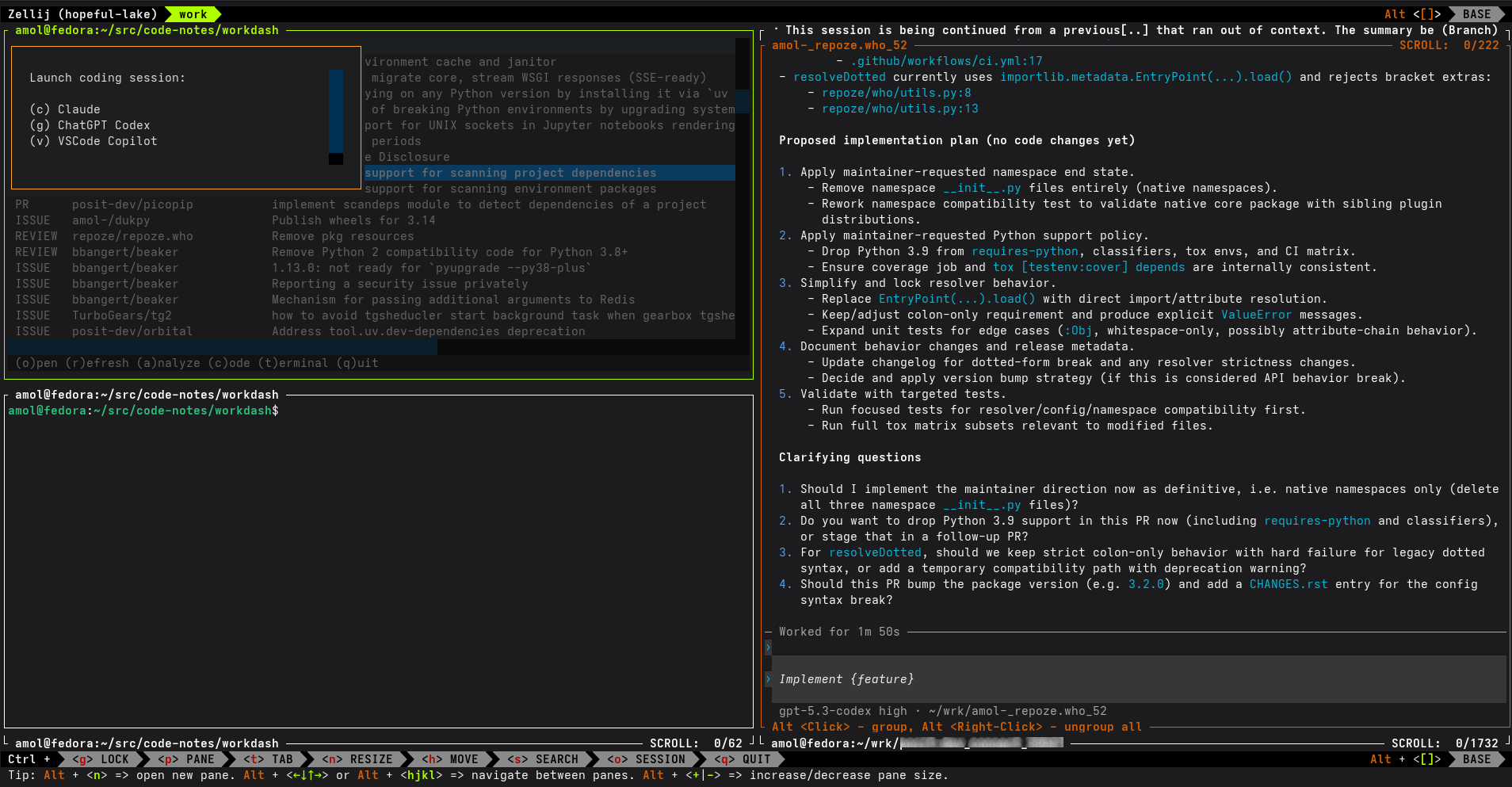
Workdash
Workdash is design around the concept that everything can be done by starting some tool in some terminal. So all I need, is a dashboard that spawns terminals and interacts with them.
Zellij, with its powerful IPCs and zellij server looked like the perfect tool for this job, if I had a dashboard that was able to speak Zellij, then the dashboard could do everything just by sending commands other terminals via the zellij protocol.
Even further, if Zellij was already good at coordinating terminals, why would I have to do that job at all? What I needed was a dashboard that ran in Zellij and integrated with Zellij natively while allowing me to replace any other component of its stack as far as it could be executed in a terminal.
The dashboard could focus on the issues and repositories I had to manage, while git could remain git, the editor remains the editor, the agent harness remained the agent harness. Yes, like for Unix Pipes some infrastructure had to exist so tools can integrate, but each tool would focus on what it did best.
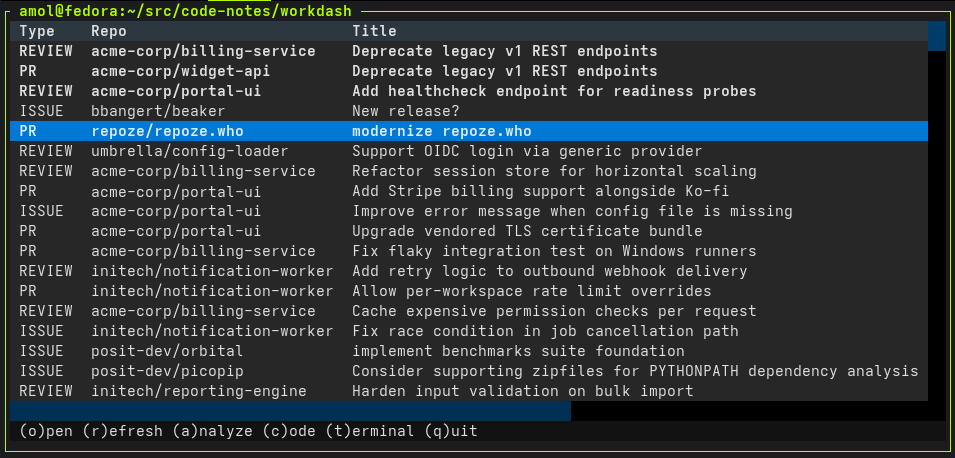
At this point I have been using workdash for a few months, and I had enough success with it that I felt I was probably not going to drop it any time soon. And if it had value for me, maybe it could have value for someone else, so why not share it?
I do realize at the moment there is a lot that has to improve so that it can integrate with everyone favorite tool. It was born out of my own needs and I hope by publishing it that it will have the opportunity to evolve based on other people needs too.
Certainly it needs support for more coding agents ( I have been playing around with Pi.dev a lot recently and I love it ), other repositories ( I have some personal projects on Codeberg.org and at the moment workdash is heavily focused on Github ) and so on…
It still lacks many capabilities for which the “(t)erminal” button is there. But hey! In the end it all started because my original question was “why can’t I just open a shell here?”